


10 Weird Things People Do to Fall Asleep That Might Work
If you’ve ever tried to fall asleep by trying harder, you already know how badly that goes.
Somewhere between counting sheep and spiraling about tomorrow’s to-do list, people started inventing their own strange little sleep rituals. This has nothing to do with science-backed tips and expert suggestions. Just whatever quiets the brain long enough to drift off.
Here are some of the weirdest, most oddly specific sleep tricks people swear by. They’re backed by nothing but lived experience… and honestly, that might be the point.
1. Narrating a Boring Task in Painful Detail
This one sounds ridiculous until you try it. Then suddenly, you’re asleep with zero memory of how it happened.
The idea is to give your brain something so boring, so methodical, and so low-stakes that it stops spiraling and quietly powers down. It can be something as simple as mentally describing how to make a peanut butter sandwich in excruciating detail. Not the highlights, but every single step.
You open the cupboard.
You reach for the jar.
You twist the lid.
You notice a little resistance.
You set it on the counter…
Most people never make it past the bread.
Others do the same thing with equally mundane tasks. Folding laundry one sock at a time. Loading the dishwasher. Walking through every step of a familiar commute. The key is that nothing interesting happens. There’s no plot, no stakes, no problem to solve.
What makes this work is that it gently occupies the part of your brain that likes to chatter without triggering emotion or alertness. It’s just engaging enough to drown out intrusive thoughts, but dull enough to lull you into sleep.
2. Mentally Walking Through a Familiar Place
Sometimes the fastest way to fall asleep is to take your mind somewhere it already feels safe.
This works best with places that carry emotional calm, like a childhood home, a grandparent’s house, a favorite campground, or a quiet stretch of beach you’ve walked more times than you can count.
Start at the beginning and move slowly.
Picture opening the door. Walking down the hallway. Noticing the light, the sounds, the textures under your feet. Let yourself linger on small, unimportant details. The shape of a room. The way the air feels at night. The memory of silence.
Some people imagine walking from a campsite down to the water. Others drift room by room through a house they loved growing up in. Others still picture sitting still on a boat, feeling it gently rock as they stare out at nothing in particular.
The reason this works is that these places don’t demand anything from you. There’s no outcome to chase and no problem to solve. Your nervous system recognizes the safety, and your body starts to soften.
You don’t need to finish the walk. Most people fall asleep long before they reach the end.
3. Counting Backward in a Way That’s Annoying but Not Hard
If your brain refuses to shut up, give it something mildly irritating to chew on.
Not sheep. Not 1, 2, 3. Those are too easy, and your thoughts will bulldoze right through them.
The trick is counting backward in a way that requires just enough focus to crowd out mental noise, without waking your brain up. Three-digit numbers work especially well. Start at something random, like 726, and count down slowly.
Your mind has to stay engaged enough to keep track, but not engaged enough to spiral into planning, worrying, or replaying conversations from 2017. It’s the sweet spot between boredom and effort.
If you lose your place, that’s fine. Pick another number and keep going. The goal is to give your brain a simple, repetitive task so it stops scanning for problems.
4. Alphabet Games That Accidentally Become Sedatives
This one looks like a harmless little brain game until you realize you’re asleep halfway through the alphabet.
Pick a category that feels neutral enough not to spark excitement. Cities, animals, first names, grocery items, or movie titles are all good picks. Then start working your way through the alphabet, listing one or two examples per letter.
A… apple, Athens.
B… bread, Boston.
C… carrots, Copenhagen.
The magic is in how gently distracting it is. Your brain stays just busy enough to stop chasing anxious thoughts, but not stimulated enough to stay awake. It’s repetitive, predictable, and pleasantly boring.
If you get stuck on a letter, that’s actually a bonus. Your mind slows down, searches, then often fades out mid-thought. Some people even restart from A if they forget where they were, which makes the whole thing even more sleep-inducing.
The key is choosing categories that don’t make you hungry, nostalgic, or emotionally charged. Food can backfire. Childhood memories can keep you awake. So, keep it bland.
5. Imagining Being Somewhere Vast and Empty
Picture yourself somewhere wide, slow, and mostly empty. An open ocean with no land in sight. A desert at dusk. A long, quiet train moving through the countryside. A river at night, barely rippling as it carries you along.
The setting matters less than the feeling. There’s nothing you need to do, nothing to decide, and no one waiting for you. Just stillness, distance, and gentle motion.
Many people find that imagining subtle movement helps even more. Something like the slow rocking of a boat, the hum of an engine, ot the steady rhythm of water against a shore. These details give your nervous system something soothing to sync with, without pulling you into a storyline.
What makes this pre-bedtime relaxation trick work is psychological distance. By placing yourself far from your daily life, your brain gets a break from problem-solving and self-monitoring. The mind stops scanning for threats and starts drifting.
6. Pressing Your Feet Into the Mattress and Slowing Your Exhale
When your mind won’t shut up, it helps to give your body something simple and physical to focus on.
Start by pressing your feet gently but firmly into the mattress. Feel the surface push back. Then shift your attention to your breath and slow your exhale just a little longer than your inhale.
This works because it pulls your nervous system out of your head and back into your body. The pressure through your feet signals safety. The long exhale tells your brain it’s okay to stand down. Together, they flip the switch from alert mode into rest mode.
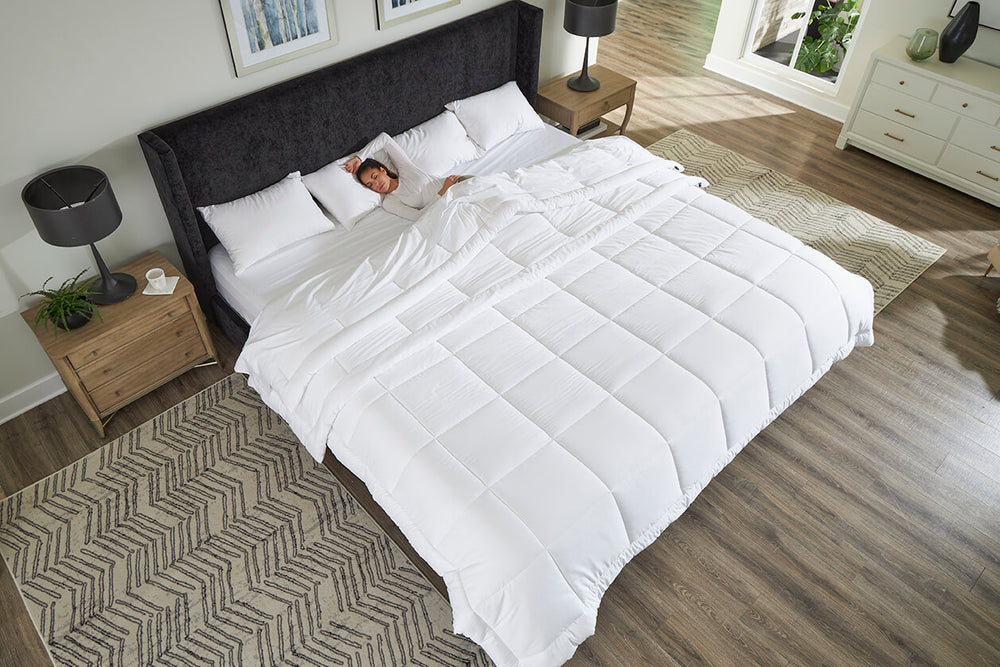
This is where your sleep surface really matters. On an oversized mattress, you’re not fighting for space or bracing against someone else’s movement. There’s room to ground yourself fully, stretch out, and let your body settle without tension.
For families who share a bed, this becomes even more important. A giant bed for the whole family needs to support everyone’s nervous system, not just fit everyone physically. When parents, kids, and even pets have space to relax without bumping into each other, falling asleep feels less like a negotiation and more like a natural unwind.
7. Listening to the Same Predictable Audio Every Night
Pick one piece of audio and use it every single night. The key is that it’s predictable, low-stakes, and slightly boring, like a familiar podcast, a voice you’ve heard a hundred times, or a documentary you already know the ending to. Something steady enough that your brain stops trying to follow along.
Over time, your nervous system learns the pattern. That sound becomes a signal that it’s safe to power down.
What matters is consistency, not quality. In fact, the worse the content, the better it often works. Repetitive topics, rambling voices, and familiar pacing give your mind something to rest against without pulling it into focus.
Volume matters too. Keep it low enough that you’re not straining to hear every word, but not so low that silence creeps back in and your thoughts take over. You want it to fade into the background, not demand attention.
This is especially effective if your brain spins the moment your head hits the pillow. Instead of fighting those thoughts, you gently crowd them out with something predictable. Night after night, your brain starts associating that sound with sleep, and eventually it does the work for you.
8. Daydreaming on Purpose
Instead of trying to clear your mind, you give it something gentle and low-stakes to wander through. The trick is to keep the daydream intentionally uneventful. Forget about plot twists, emotional spikes, or goals to reach. Think of it like background scenery, not a story you need to finish.
Some people imagine themselves floating. Others replay a calm moment from the past, such as a familiar walk, sitting somewhere quiet, or watching waves rolling in or clouds moving across the sky. The details can be vivid, but the action should be minimal.
If your mind starts getting too invested, let the scene blur. If it jumps to something stressful, gently steer it back without forcing it. You’re not trying to stay awake and imagine. You’re letting your brain idle.
When done on purpose, daydreaming becomes a soft bridge between being awake and being asleep. You don’t fall into sleep. You drift into it.
9. Repeating Simple Ideas or Mantras
Instead of replaying conversations or mentally rewriting tomorrow, you give your mind one simple phrase to rest on.
It can be as basic as a single word repeated slowly. Or a short, steady phrase you say in your head on each exhale. Some people pair it with breathing. Inhale. Exhale. Repeat. Others sync it to the rhythm of their heartbeat or the feeling of the mattress beneath them.
You do not need to feel calm for it to work. You just need to keep returning to the same idea every time your mind wanders.
If the phrase starts to fade, that is usually a good sign. It means your brain is letting go. If you forget what you were repeating, do not restart from the beginning. Let that gap exist. Sleep often slips in right there.
10. Doing Absolutely Nothing and Letting Sleep Happen
Instead of adding another trick, another thought exercise, or another attempt to make sleep happen, you do the opposite. You stop trying altogether.
Most sleep troubles come from too much effort. It’s things like checking the clock, wondering why you are still awake, and treating sleep like a task you are failing.
When you give yourself permission to be awake, the pressure drops. Your muscles soften, your breathing settles on its own, and your mind loses interest because there is nothing left to manage.
You are not trying to fall asleep. You are just resting in a safe, comfortable place and letting whatever happens happen.
Ironically, this is often when sleep finally shows up.
Weird Is Better Than Wired
Sleep doesn’t always respond to rules, schedules, or perfectly optimized routines. More often, it responds to small rituals that feel a little strange, deeply personal, and surprisingly comforting, especially when they give your mind something gentle to rest on instead of something to solve.
What all of these habits have in common is that they remove pressure. They stop sleep from feeling like a performance or a problem to fix and turn it back into something your body naturally knows how to do when it feels safe, settled, and unbothered.
If you’re creating a sleep routine that works for you (or your whole family), start with the foundation.
Explore our collection of oversized mattresses designed for deep rest, shared sleep, and unhurried nights. When your body has room to relax, your mind usually follows.